
Imagine you are standing in front of The Kiss painting for the first time. Not in a book, not on a screen. In the room, at the Belvedere in Vienna, with a hundred other people around you and the painting hanging at eye level. You step to the left. The gold goes cool. You step to the right. It flares. You step back and it settles into a warm, deep shimmer that does not look like paint at all. You are looking at metal, on a canvas, painted by a man whose father cut gold for a living.
That is the part almost every article about this painting skips. They tell you it is a masterpiece of the Vienna Secession, they tell you it is about love, they tell you it is one of the most reproduced images in the world. None of that explains what actually happens when you stand in front of it. The canvas is 180 by 180 centimetres, square, painted between 1907 and 1908, and what it does to your eye is not something any writer can describe from a photograph. You have to see it. Or you have to know what Klimt did.
His Father Cut Gold for a Living
Ernst Klimt the Elder was a gold engraver. He spent his working life cutting patterns into metal, and his son grew up in a house where gold sheets were as ordinary as paper. By the time Gustav reached his forties, he had spent decades watching gold behave: how it flattens when you press it, how it lifts when the light changes, how it refuses to be a colour and insists on being a material.
Then in 1903 he went to Ravenna. He spent time in San Vitale and the Mausoleum of Galla Placidia, both covered in sixth-century Byzantine mosaics. Figures against flat gold ground. Faces outlined in dark tile. Haloes built from individual glass cubes that catch light and throw it back at the viewer. The mosaics do not paint light. They emit it. Klimt came home and started doing the same thing on canvas.
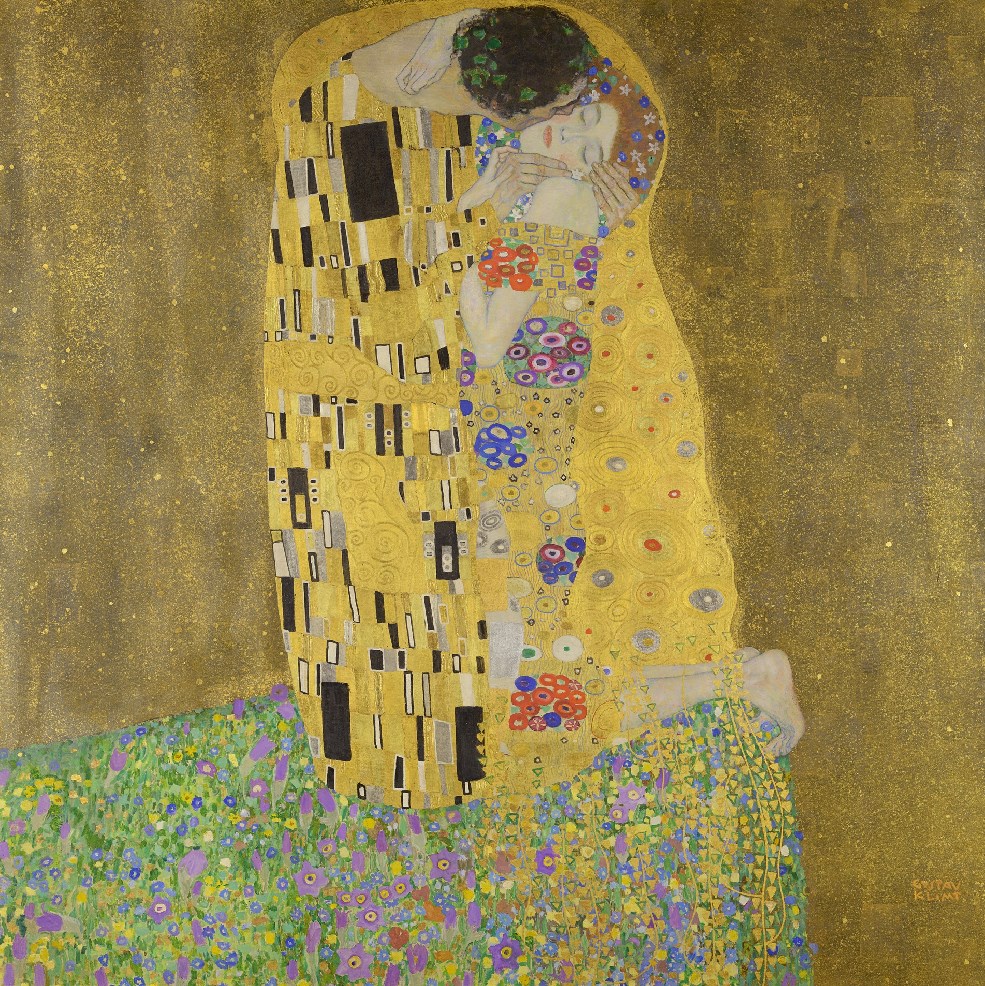 The Kiss, 1907 to 1908. Oil and gold leaf on canvas, 180 by 180 centimetres. Belvedere Museum, Vienna. View in high resolution on Google Arts & Culture.
What Gold Leaf Actually Does
Gold leaf is thin. A single sheet is about one tenth of a micrometre, and if you breathe on it wrong it tears. Klimt applied it with a gilder's tip, a flat brush used to lift the sheet without touching it, then pressed it down with a burnisher. Depending on the passage, the adhesive was gesso or a mordant. Once the gold was laid, he painted into it, working the oil figures on top of and into the metal.
Here is what that produces, and it is not a small thing. Gold reflects light at a specific wavelength, and that reflection changes with the angle of the viewer. Move to the left, and a panel that looked deep and warm goes cool and pale. Move to the right, and it flashes. There is no pigment on earth that behaves this way. Gold is not a colour. It is a material with its own optical behaviour, and Klimt placed it exactly where he wanted the painting to breathe.
Why does this matter? Because the entire drama of The Kiss lives in the way that gold sits next to oil. The faces are painted in oil. The skin is oil. The grass at the bottom edge is oil. Everything else is metal, and the metal is what the eye keeps returning to.
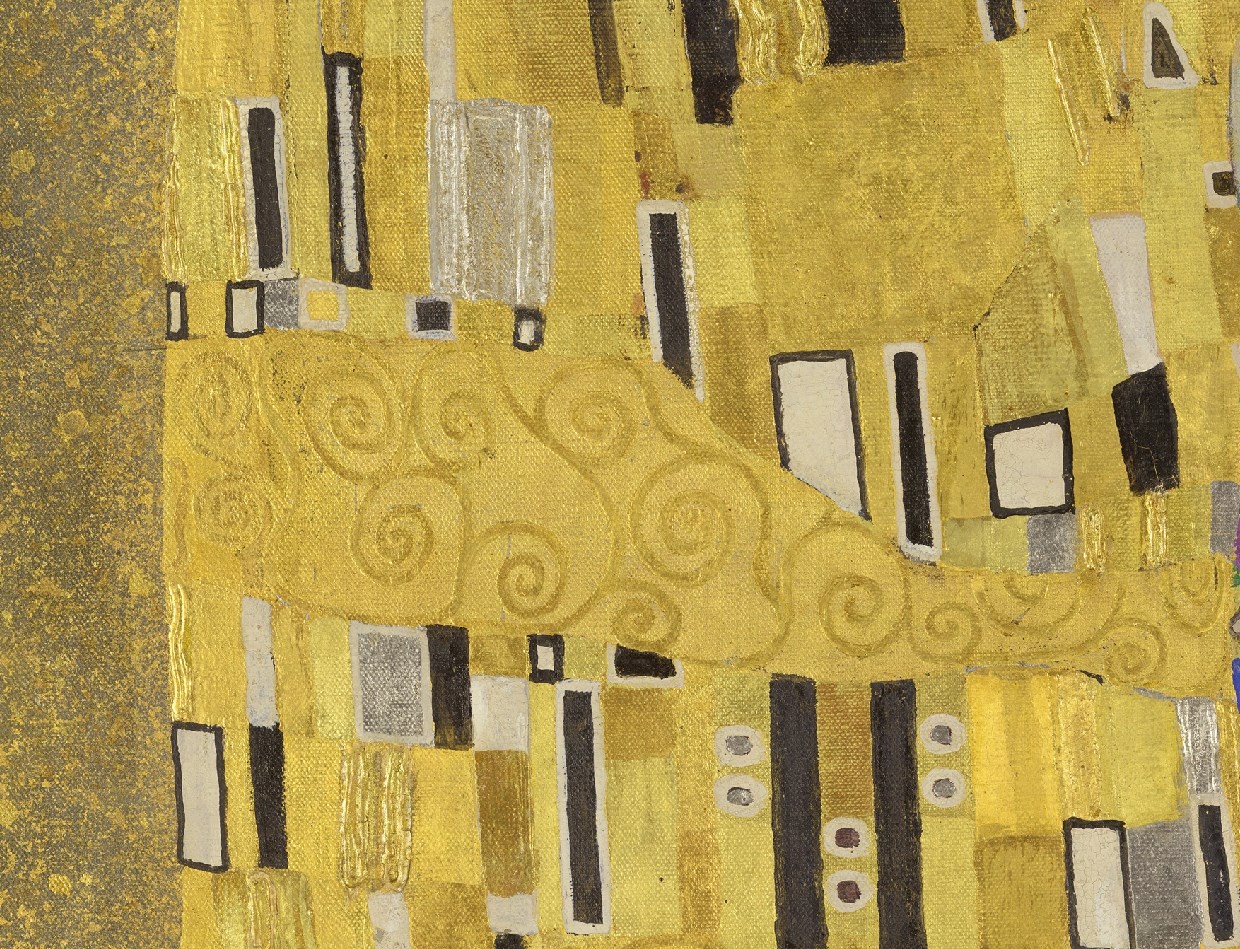 Gold leaf is roughly one tenth of a micrometre thick. It reflects light at a specific wavelength, and the reflection shifts with the viewing angle. No pigment imitates this.
The Faces Are the Only Place the Canvas Holds Still
Now look at the heads. The man's face is almost hidden. His cheek presses against the woman's, and we see only the back of his skull and a slice of jaw. The woman faces us with her eyes closed, lips slightly parted, head tilted back. No gold on either face. The metal stops at the neck and the wrists.
Why would Klimt do that? If the gold is the best thing in the painting, why leave the faces bare? Because a face painted in gold leaf would be a mask. The whole point of The Kiss is that two people are close enough to feel each other's skin, and skin cannot be made of metal. The gold is the world. The oil is the body.
Look at the hands. The man's hand cradles the woman's cheek. Her hand lies over his. Her fingers are long, painted with the same care you would give to a portrait commission. Below, a foot curls around the woman's calf. It is an awkward detail, almost childlike, and it breaks the symmetry of the composition in a way that feels deliberate. The rest of the painting is pattern. Those two faces and those hands are the only place the canvas holds still.
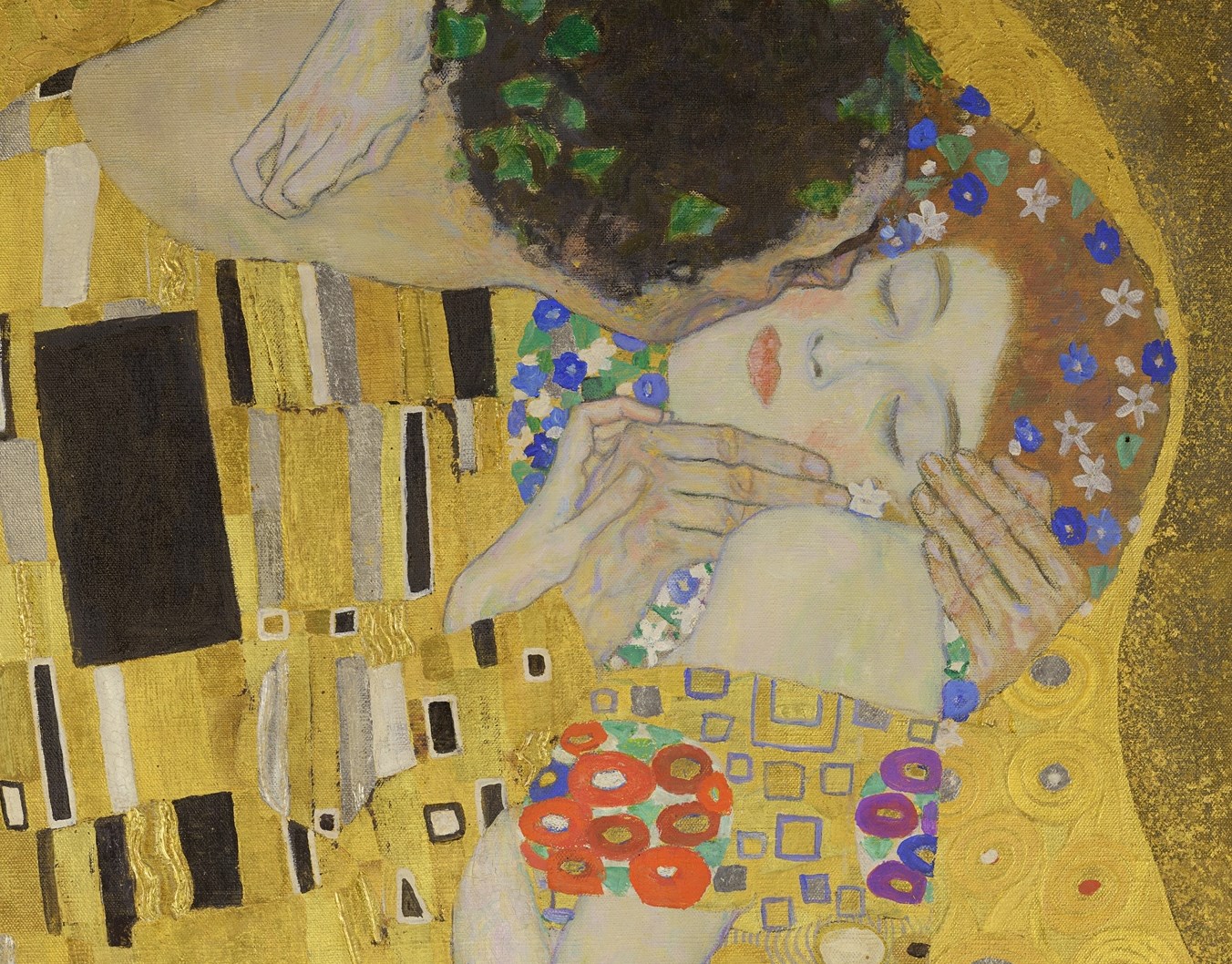 The skin is oil paint. The gold stops at the neck and the wrists. What makes the faces feel close is not the pattern around them but the tension in the hands.
Why Every Print You Have Ever Seen Fails
Digital printing cannot reproduce gold leaf. It lays pigment in a flat layer across the image, and the metallic passages turn into a warm yellow-brown that sits on the paper the same way a shadow would. The reflection is gone. The angle-dependent shift is gone. What remains is a picture of a painting, and a picture of gold is not gold.
This is not a minor loss. It is the entire painting. Every reproduction of The Kiss you have seen on a poster, a postcard, a t-shirt, a phone case, has flattened the thing Klimt spent months laying down by hand. The image is there. The painting is not.
A hand-painted oil reproduction is built the way Klimt built the original. Ground first. Then the oil passages of the skin and the grass, painted thin and allowed to dry. Then the gold leaf, applied with a gilder's tip in the same rectangular panels and swirls Klimt used, pressed down with a burnisher, and painted into with oil where the figures cross the metal. The result is a canvas that behaves the way the original behaves, catching the light from your room the way The Kiss catches light in Vienna.
See The Kiss as a hand-painted oil reproduction at oilpaintings.com. The skin is painted in oil first, then the gold leaf is applied in panels, then the pattern is worked into the metal, exactly as Klimt worked it. View the painting
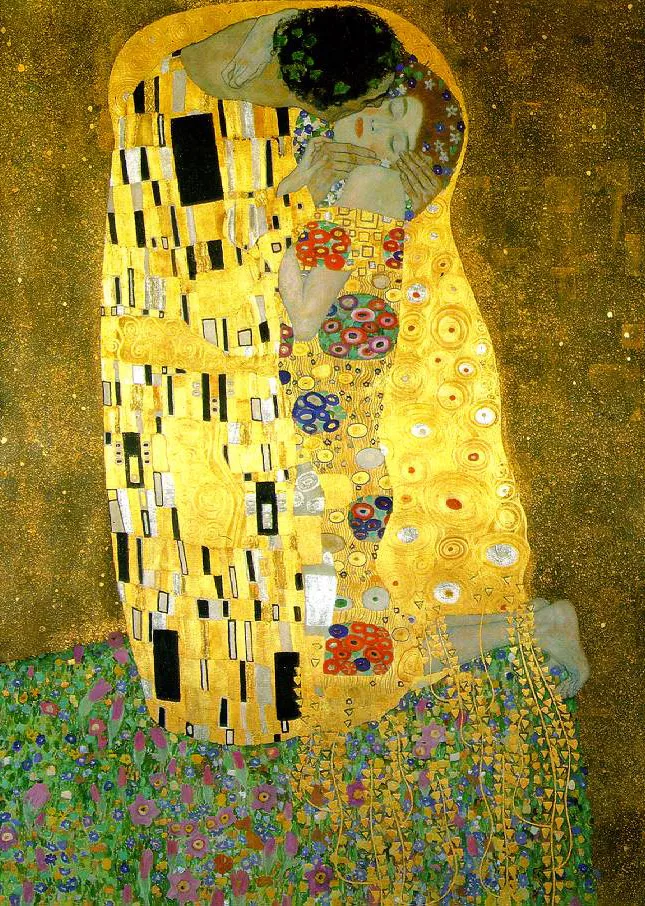 A hand-painted reproduction. The gold leaf is applied in panels, the same way Klimt applied it, and worked into with oil where the figures cross the metal.
What to Look For If You Ever See It
Stand in front of the painting and shift your weight from one foot to the other. The gold panels will change. Some go cool, some go pale, some flare. The effect is not uniform, and it is not decorative. It is the material doing what metal does, and Klimt built the composition around it. Then look at the hands, and at the way the man's cheek presses against the woman's. Everything else in the painting is pattern. Those are the only two places where the canvas holds still.
The painting was bought by the Austrian state in 1908, the year it was first exhibited at the Kunstschau. It has been at the Belvedere since 1918, with a pause during the Second World War, when it was stored in a castle in Lower Austria with other Klimt works and returned to the museum in 1945. When you see it today, you are looking at a canvas that has been watched for over a hundred years, and it still does the thing it was made to do.
Images: Wikimedia Commons (public domain).